
Regenerative agriculture refers to farming in a way that improves the health of the land and the ecosystem, rather than depleting it. These practices not only help the environment, but also help the long-term financial viability of your farm and make you more resilient to variability caused by climate change.
Below are some different types of practices you can consider implementing on your farm. A few great resources for regenerative farming in general include:
- The Quivira Coalition is an organization that works nationally but is based in Santa Fe. They have tons of resources on regenerative farming and ranching, they do farmer training, produce a podcast and have an annual conference called Regenerate held in Santa Fe (this year’s conference is October 26-28, 2026).
- That Natural Resources Conservation Service of the USDA is offering a new Regeneratve Pilot Project to provide funding for regenerative practices.
- Western SARE has a lot of resources on sustainable agriculture and they offer a grant program for farmer-led research on regenerative practices.
- ATTRA has a ton of resources on sustainable farming; it’s a national resource, so some publications may be more relevant to NM than others.
Rotational Grazing & Silvopasture
Rotational grazing is an effective tool for maintaining the health of grazing land. It means dividing your pasture land into fenced off portions that you move animals from one to the other so that you can give portions of the land a rest and time to regrow vegetation.
This is a brief overview of rotational grazing from the NRCS. NRCS Rotational Grazing
This is a 5-minute video of an NM rancher describing his rotational grazing system.
Agroforestry
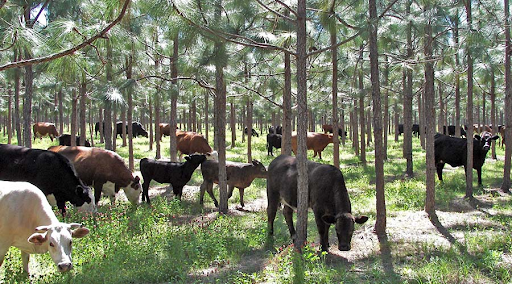
Silvopasture is a technique which combines raising trees in the same land as rotational grazing from agriculture. This could mean pasturing chickens in your apple orchard or grazing sheep on a christmas tree farm. Here is a brief overview of silovpasture: https://smallfarms.cornell.edu/2018/06/six-key-principles-for-a-successful-silvopasture/
This is a deep dive course on silvopasture: https://www.silvopasture.org/
Pollinator Habitat
Pollinators are a key part of the ecosystem and the success of our own farm products. Abundant and healthy populations of pollinators can improve fruit set and quality, and increase fruit size. In farming situations this increases production per acre. In the wild, biodiversity increases and wildlife food sources increase.
Unfortunately, the numbers of both native pollinators and domesticated bee populations are declining. They are threatened by habitat loss, disease, and the excessive and inappropriate use of pesticides. It is imperative that we take immediate steps to help pollinator populations thrive. The beauty of the situation is that by supporting pollinators’ need for habitat, we support our own needs for food and support diversity in the natural world.
This is a list from NMSU of best perennials for pollinator habitat that grow well in NM: https://pubs.nmsu.edu/_h/H182/index.html
The Xerces Society offers farms and ranches free kits to build pollinator habitat: https://xerces.org/pollinator-conservation/habitat-kits/new-mexico
This is an in-depth guide to building pollinator habitats in our region: https://pollinator.org/PDFs/Guides/ArizonaNewMexicorx4FINAL.pdf
Soil Health & Cover Cropping
This is a guide that has a number of the most beneficial carbon sequestering practices that can also benefit your overall farm health. https://attra.ncat.org/publication/climate-beneficial-practices/
NRCS Conservation Practice Funding
The National Resource Conservation Service (NRCS) has a variety of programs that provide technical assistance and sometimes funding to implement conservation practices. Funding for these programs has been recently renewed and they have a new pilot program that is addressing conservation in a more wholistic approach.
This is the state page for NRCS which has contact info for the statewide office and county offices. It also has an overview of the NRCS programs available: https://www.nrcs.usda.gov/state-offices/new-mexico
Leave a Reply