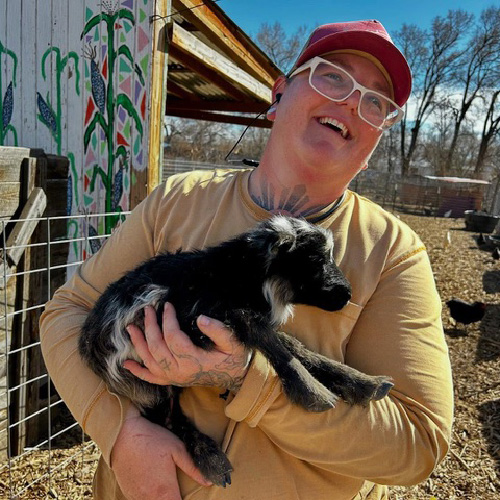
What do you wish you had known when you started farming?
I would have told myself to maintain a life that isn’t just the farm. I got to a point where I was severely burnt out then had no choice but to take some space from the farm. We all hear about burnout so it’s not like I didn’t know it was a thing, but I didn’t know what steps to take to avoid it, and what I learned is that it’s important to not have everything in my life and all of my identity be about farming. I think that when you’re building something new, that period of intensity and 60-80 hour work weeks is kind of necessary, but I think it’s helpful to approach that with a 3-5 year plan of how to get out of that level of intensity because you can’t maintain that long-term.
What do you think made your farm successful? What helped it to survive when so many don’t?
Two things. Having a patron was a big one. But also building out an expansive community of support. That looks like having a crew that feels empowered in their day-to-day, that wants to stick around and take on more responsibility. We started a whole milking coop in order to distribute the tasks of livestock care and milking. We have a distributed sales model, including a CSA whose members are really committed to the farm, beyond just buying the produce but also farm-sitting and volunteering. Having a robust volunteer and workshare program which then creates a pool of trusted folks when you are able to hire employees. Having a network of mentors who I could and did call on when I had questions or problems I needed help solving. It does take work to manage all these things, but the biggest challenge for me in this was honestly letting go of my ego and the idea that I was the only one who could do this stuff well. I needed to be okay with things looking a different way than how I would have done them. I am also a natural community organizer, so I recognize that managing volunteers might be easier for me than other folks.
How did the mission for Chispas come to be?
The property owner had prioritized purchasing the land so that it wouldn’t be developed. He wanted to grow food and keep the land in the community, so that was the mission I was given. But I dreamed bigger than that and had loftier goals around food sovereignty and building community. I wanted it to be not only a hub for food, but also for people and for exchange of information around food and farming. I wanted to see how we could be a conduit not just for getting fresh healthy food out into the community but for getting as many people as possible to the land, be it farm related or not. And since then it’s been shaped by the other people involved in our more distributed leadership model. In transferring the farm to new leadership it’s been cool to see how much of the mission they want to maintain while also working towards their own new goals and dreams.That’s exactly the kind of energy that space deserves.
For someone that’s just starting a farm is it important for them to have a mission?
Yeah of some kind, at least a clear goal. It doesn’t have to be so specific, but you need to have a clear vision of where you are going to, and to give yourself something to measure against. Like my personal five year mission is just to grow food, so I can look at that and say, yeah, I’m not doing half bad.The energy and resource and self that it takes to grow food, if you don’t have dreams of what it could be, you should probably go work with some other people until you figure that out. How is the universe going to send you what it is you need if you can’t be clear about what it is you want.
Is your mission statement something that you refer back to or use when you’re making decisions?
Yeah, every year in the winter we sit down and re-read the mission and the goals we’d set for ourselves and each other and recommit to the obligations that we wanna do for the year. It’s also a really important part of bringing new people in, so we can clearly explain to them what it is we’re doing and why that matters. For many people our community-oriented vision is a draw for people getting involved, so we need to keep reminding ourselves of what we’re doing and show the new people coming in that we are committed and that if they want to be involved they need to commit to it too.
Does having a mission statement affect your marketing?
I don’t know that having a mission statement specifically affects marketing except that it helps us set priorities for customers and places that we sell to. It means we don’t prioritize restaurants, but CSA and direct-to-consumer and wholesale customers who really align with our vision. We’re not trying to be in high-end restaurants; we’re trying to feed real people.
It also is important for us in telling our story to our customers. People are curious and that’s why people go to the farmers’ market or join the CSA. They want to know “who are you, why are you doing this, what’s your story?” The more they know about you and your story the more they want to bend over backwards to help you get where you’re going. For example, people ask why we’re not organic and my answer is that because our program is so relationship-based that we don’t need a certification for people to know how we’re growing. They can come to the farm and see.
What’s the connection between a mission and a business plan, and is it important to have a business plan?
When I started at Chispas I did write a business plan because it was part of what we needed to have for our patron and also to be clear about our budget and so that we could get the work done for as little as possible and be self-sustaining. I’m now running the Grow the Growers program at Bernalillo County and we are doing a Tuesday workshop series about farm business planning. That’s something that the program has had a big emphasis on: helping people who are leaving the program be ready to start their own business. but That said, I’m stepping away from that a bit because there is so much that farmers need to learn. It’s kind of unrealistic to ask someone to know exactly what they want to be doing in their first few growing seasons.
You’re considered a beginning farmer until you’ve been growing for 10 years. And it wasn’t until I had farmed 10 seasons that I actually understood why. So expecting them to start their own business right away might be setting them back as I think they need to focus on their relationships with existing farms, learning core skills, and getting a foundation of knowledge. Let them take some time working for other people and make it clear it doesn’t have to be a solo endeavor, and that there are more and more examples of collaborative farming projects that are profitable. We want people to look at sustainability not just in growing practices, but also how they are sustaining themselves to be able to come back and grow year after year. A business plan is part of that if you are one of those exceptional people that wants to start their own farm, but I want people to know that they’re not failing as a farmer if they want to work on someone else’s farm or support farms in another way.
Any last nuggets of wisdom for new farmers?
Yeah a few. First to recognize that there are a lot of amazing people already doing the work so new growers don’t need to jump in and start their own thing. They should go and meet people that are already doing the thing you wanna do and volunteer or get some paid work and see how they do things. Don’t just expect to jump in and exert your will in a field that requires such a breadth of experience. I’ve seen a lot of people invest a lot of money in starting a farm business only to find out how little they know, when they could have started at step one which is networking and building relationships and learning from others.
You don’t know how much you don’t know until you actually know something. In ag there’s a million different ways to do something and no way is the wrong way if it works for you and gets the results you’re looking for. You don’t have to reinvent every wheel, which is why one of my biggest recommendations is to find a mentor, someone that you really like working with and vibe with in many different ways, and actually call on them when you need help and be there to support them however you can.
The last thing is not to romanticize agriculture. While it is one of the most meaningful things you can dedicate your time to, it is not beautiful or easy all the time. Get enough real experience before you decide to start your own thing. It’s one of those things that you can put your whole entire self into and still fail. It’s one of the most humbling things you can do because ultimately your job is just to listen, observe, and respond accordingly year after year after year.