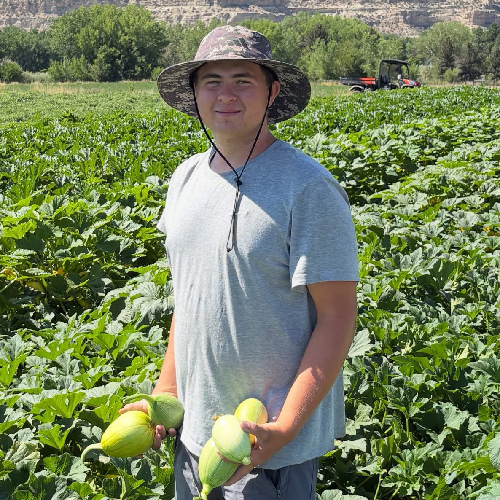
What do you grow?
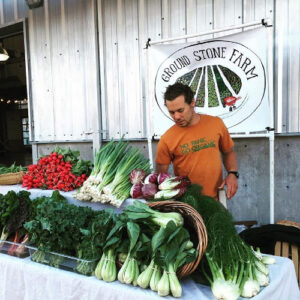
I grow the following vegetables: tomatoes, melons, cherry tomatoes, beets, watermelon, cucumbers, eggplant, speciality sweet peppers, okra, hot peppers, broccoli, green chile, and cauliflower.
Where do you sell your food?
I sell predominantly through institutional sales through the New Mexico Approved Supplier Program, farm stand, and the farmers market
How did you get into farming?
In 2020 during COVID, when I was 14 or 15, I became a backyard gardener because I was bored and needed something to tinker with and let my mind wander. My mom encouraged me to get outside and not lounge around the house all day. I enjoyed planting flowers and ornamentals and watching them grow in our backyard. Over that winter, I spent a lot of time learning about and growing houseplants. At one time, I had 90 to 100 houseplants.
My dad shared that the New Mexico State University San Juan County Extension Office had a Master Gardener Program. So that spring (2021), I enrolled in the program taught by the county extension agent. Because they also have a farm there called Growing Forward Farm, with a farmer incubator program, I met the coordinator. He encouraged me to join the month-long program, where I learned more about vegetable gardening and farming, while also listening to other people who wanted to be farmers or become full-time backyard gardeners.
At the time, since I was growing flowers and ornamentals, it was really interesting to learn and hear about growing vegetables for your own consumption and for selling at the farmers market. He convinced me to become an incubator farmer at their farm.
The incubator program at Growing Forward Farm provided knowledge and expertise that I didn’t have.
They showed me how to build a crop plan, where to get seeds, how to irrigate, how to scout for pests—the best practices to grow a healthy and sustainable plant and product. I paid a very minimal lease rate, and the program provided everything to grow a crop—land, water, seed, tools, irrigation equipment, and help assembling a drip system. During that first season, the farm had an event where I met the Student Nutrition Program Supervisor for Farmington Municipal Schools.
When she found out I was a high school student at Farmington High, growing all this food, she wanted to buy every last pepper, tomato, and melon I produced for FMS schools. The initial plan was to experiment with crops, throw some stuff out there, and see what happens. There was a roadside stand near the farm where I sold a bit, but 99% of what I grew went straight to FMS schools! The resources I had access to and the mentors I learned from at the incubator farm, along with the connection I made in that very first year, allowed me to make money that I saved and used as start-up capital to eventually build my own business.
What was your experience with the Approved Supplier Program process?
In order to sell to the schools, I needed to be an Approved Supplier, which at that time, I did through the Harvest Food Hub in Farmington. The application comes out in April, and they usually try to get everyone approved by July or the fall when monies for the schools and senior centers are dispensed. The Approved Supplier process allows you to sell your produce to institutions directly and puts a stamp of approval on your product from a food safety standpoint. They provide two levels of food safety training to give you information, so you know what to address in your food safety plan. The application in the first year was the hardest to complete. It’s a long packet that is very thorough, with things you may not have necessarily thought about. Being able to get help for four to five hours from the county extension agent to go through the application and build out a food safety plan was a big deal, especially for a first-time farmer. How you’re washing your produce, how you clean surfaces, what’s happening in your field with wildlife, how you’re irrigating, what you’re irrigating with, what’s happening on your neighbor’s property, and whether there is a septic system—you need to consider all external and internal factors on your farm.
The food safety plan is a big part of the application and addresses the procedures and processes to deal with all potential hazards. There needs to be an SOP (standard operating procedure) for the handling of particular products—harvest, post-harvest, even a delivery SOP. After the application is turned in and reviewed, you get a phone call to go over what remains a concern and how you can address that problem differently. You can get approval of your application through that phone call, or they may also inspect your operation if they feel it’s needed.
After approval, the ASP team can also do a random field check at any time during that season. The annual reapplication is a shorter process. That’s important because we as farmers have systems that may change from year to year. Be prepared that the entire application and review process can take two to three months. In some years, we have a crop planted, it’s almost ready to harvest, and then we’re finally getting approved, so there’s a little bit of a risk. It’s not that you won’t get approved, it’s just that the process can take some time.
Packaging for large quantities and at scale. I had to go out and get a bigger truck, something with a bigger bed, to move a larger quantity of product at one time without making two or three trips. Even extra labor, because you need someone to weigh those products, label, package, and get them ready for loading and delivery. An RTV (rough terrain vehicle) is necessary when moving 5,000 pounds of produce a week. You and your employees don’t want to carry that a quarter mile back to your farm stand/processing area.
Why are institutional sales important to your business?
I move the greatest volume of produce through institutional sales, so they are my first consideration when it comes to planning. Our wholesale accounts allow us to grow more quantity and more variety. For example, last year, if I just sold our seedless watermelon at the farmers’ market, I wouldn’t have been able to sell the quantity I needed to justify the cost it took to grow them. Being on the Approved Supplier list, I get a very fair price for our products and can set them as I wish. I try to be as competitive as possible with our pricing but need to be higher on certain products to justify growing them, such as cherry tomatoes, which are labor intensive. Finding good employees is honestly our biggest challenge.
By and large, institutional sales are less risky than growing something that you hope will sell at a farmers’ market. But there is also no guarantee. We’ve had a situation where buyers say they want certain products. We predict they will be really good customers, but they end up buying close to zero after we planned and grew those crops. Not knowing if someone will purchase our crop when it’s ripe and ready to go is a big deal. In that situation, I reached out to other buyers who ended up coming through for us.
What are your considerations when planning what you’ll grow?
I move the most volume of produce through institutional sales, so they are my first consideration when it comes to selecting what I should grow. I like to take the approach of reaching out to institutional buyers, calling them, and seeing how I can meet them 80% of the way there. It’s important to make it as easy as possible for the school accounts.
It’s a physically demanding process to chop and cut fresh vegetables in the quantity that the schools need daily. I do not have the facility nor want to assume the risk involved to provide that processing. I’ve had to find products that are more suitable for their kitchen staff to process in a timely manner. I’ve been told by one of our institutions that they won’t buy green beans because they can buy them frozen and cut for less than a dollar a pound. Schools here prefer locally grown and want to support local farmers; they also need to feed a lot of kids and process that food in a manner that doesn’t cause all their kitchen staff to quit.
After considering my institutional buyers’ needs, I’ll fill in with things that are more niche products, like specialty melons, interesting varieties of tomatoes, heirloom varieties, and specialty peppers for the farm stand and farmers’ markets. Crop planning for the farm stand versus institutional sales is different because you have to stagger smaller blocks that you’ll harvest on a weekly basis rather than having a large quantity of something for harvest all at once.
How do you find workers for your farming business?
Finding good employees is honestly our biggest challenge. Last year at our current location, I had 15 different employees throughout the season. Most of them were contacts from the property I’m leasing or family contacts. Some came by the farmstand looking for work. We’re always looking for whoever we can get.
What is your journey with land access?
I needed more land than what was available to me at the incubator farm to meet the demands of my institutional buyers. I intended to move to the property of a family friend and farm three acres. While planning and working out details with a local irrigation company, they mentioned another property they were working with that wanted to revitalize their produce fields and farmstand. They suggested presenting my resume and ideas to the board of trustees who managed this property that is under a conservation easement with New Mexico Land Conservancy. My ideas were very much in line with the board’s vision and goals. That is how I came to farm this current property and reopened the farmstand, which had been closed for 30 or so years. There is a formal lease agreement with payments twice a year that includes insurance and access to seven acres, with the ability to grow and expand. We’re planning to construct a couple of hoophouses and get the greenhouse back to a functioning state for starting seeds. We’re also considering some future you-pick and agrotourism ideas. Presenting to and approval from the board are necessary with any changes to our lease or possible expansion of our operation so both our needs are met. The plan is to be in a long-term lease after we figure out what’s working, what’s not, and what we can do to make adjustments.
Tell me about incorporating a farmstand element into your business.
The most appealing thing about this property is the road exposure and the existing farm stand building. It has allowed me to expand outside of institutional sales and serve another customer base. The community has access to fresh produce on a daily basis. It accommodates people’s schedules, whether they need to come after work, on a Friday afternoon with their family, or even on a Sunday after church.
We are making upgrades for ADA compliance and have attained SNAP and Double Up Food Bucks authorization. There used to be many farmstands in this area. I’ve met 75-year-old ladies who remember coming to this same farm stand with their moms. It was the event of the day when they got produce and bumped into friends. I’m hoping to bring back some of those experiences and create memories for our current community.
How do you manage wildlife in your farming operation?
Because the property I farm is under a conservation easement, there are animals everywhere. On the entire property, which is also a working ranch with many acres in alfalfa production, there are deer, racoons, skunks, beavers, coyotes, turkeys, peacocks, and the occasional mountain lion.
On my side of the river, I mostly deal with deer and turkeys that pretty much stay away because I’m hanging around my produce all the time.Luckily, the deer are more interested in the apple trees in a cooler, grassy area near the lower part of my produce fields. If there are no apples on the trees, the deer are usually not around. There is a deer fence that is effective unless a gate is left open. If I notice bite marks on a watermelon or cantaloupe, or notice that turkeys have flown in, or animal waste, I mark off the area and establish a zone that won’t be harvested. I have an SOP (standard operating procedure) that addresses that.
Nuggets of wisdom to your younger self or beginning farmers: The first thing is that farming is not as easy as I thought. It’s not just sticking a seed in the ground and expecting something to grow. You have to work for it. There’s a lot of planning involved that allows you to have a successful growing season. I would also say not to put all your eggs in one basket. When I was selling to just one customer (institutional buyer), I was very much exposed to risk. If that customer fell through, I was stuck with a lot of product, trying to figure out a way to sell it.
Over the years, I’ve added farmers’ markets and especially the farm stand, as ways to move products I wouldn’t have moved elsewhere. Especially with unpredictable events like weather, drought, or bug pressure, I’m not stuck with just one way of moving products.
How much capital did you need before starting out on your own?
The very first year I farmed, both my parents helped me with my plot. They also paid for supplies so I could make funds through sales. It took a full three years of growing, selling produce, and being frugal to save enough to make the leap from the incubator farm to the leased land we farm now. If I was someone who had a family or had a house payment, it’s probably something I could not have realistically done. It took everything to be reinvested to afford to move to the land we lease.
To accommodate the larger scale of operation, we had to buy equipment—tractor, implements, irrigation system, and an RTV (necessary when moving 5,000 pounds of produce a week from field to farmstands). Last year, there was a stressful period when we had irrigation issues, and I almost lost the field. Looking at my bank account, I thought we were going to have to start selling the truck and the tractor—to make the payments. We were very lucky that didn’t happen.
On working with Natural Resources Conservation Service:
We are trying to work with NRCS and apply for some of their programs now that I’ve farmed for one year on our leased property. When I was farming at the incubator farm, I technically did not have a lease agreement, so I didn’t qualify for their programs. You need to own or have a legal lease agreement for the land you’re farming for at least a year and show you made a small profit to qualify for the programs they offer. Since NRCS won’t fund your project right away—even if a new farmer bought a piece of land—you need enough capital to get you through that first year.