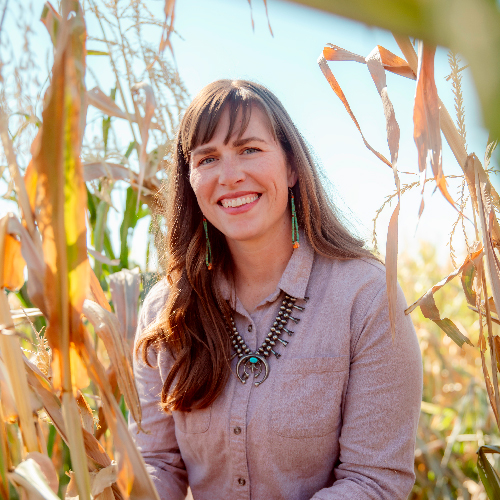
Farmer: Mary Ben
Farm Name: Bidii Baby Foods, LLC https://www.bidiibabyfoods.org/
Farm Locations:
- Shiprock, NM since 2021 (5 years)—16 acres
- Aztec, NM (currently; since January 2026)—40 acres
What do you grow?
We grow yellow, white, and blue varieties of corn for cornmeal. We specialize in processing the corn into neeshijizhii (dried steamed corn) by steaming white corn underground, then drying and grinding it into their value-added product—baby food.
We also grow the following vegetables: squash, melon, beans, amaranth grain, chile, and leafy greens.
Where do you sell your food?
We sell almost exclusively to institutions such as: IHS, food banks, schools, child-care programs, and nutrition education programs (i.e., SNAP, WIC, etc.).
How did you decide to focus on institutional sales?
It’s more convenient for us to sell in larger quantities, but it’s also a priority because, when we created the business, we wanted to focus on these foods reaching more low-income families within our region. We aren’t interested in exporting outside of the state and are very focused on our local region and the Navajo Nation. Institutional sales allow us to feed lower-income families without them dipping into their families’ budget.
What is your and Zach’s (co-founder and partner’s) background with farming, and how do you complement each other as business partners?
Zach grew up farming his entire life. He’s a sixth-generation farmer from Shiprock, specializing in dried, steamed corn (neeshijizhii), so he’d been doing that forever when we met. We started farming together about a decade ago after I moved to the area, taking a job out of graduate school. At the same time, I also volunteered on a bunch of different farms and met him through that. I have not been farming my whole life. I grew up in an urban area (Baltimore), and I think my eyes opened to farming and food production when I did the Peace Corps out of undergrad. I lived in an area (Ethiopia) where the vast majority of people are still agrarian and predominantly rely on their local producers because they live hours from any grocery store. I really wanted to stay in touch with that aspect when I came back to the U.S.
In reflecting on our Farmer-in-REZidence™ farmer training program, there seem to be two types of farmers who, when partnered together, can create a sound farm business…one person who handles more of the back end, and the bookkeeping, and marketing (in our case, myself), and another person who is more field-focused (in our case, Zach). You kind of need both of these strengths and it’s really hard to find both qualities in one person. I don’t think farming is meant to be a singular endeavor, but we as a society are training people in a singular way. Yes, know a little bit about everything, but also know your skills, and your niche and where your energy lies. Then find a business partner or a life partner that has another set of skills to balance things out
How did you go from meeting and farming together to formalizing your business with a business plan and farm mission?
We don’t have a background in business. Zach had more of a business mindset, but not from a Western perspective where you start with a business plan, form an LLC, etc. The formalization of our business…all of that came later which I think happens to a lot of farmers. In our case, the necessity to feed our child and a creative idea was the heart (the mission) that grew into a business with a sort of hybrid business model. The first year in 2021, we only established an LLC, thinking we were going to be farming and growing crops and maybe making some value-added products…and that’s it. Up until then, we had been farming with Zach’s extended family for a couple of years. Then the pandemic hit and we found out we were pregnant with our first child, who would be born right during planting season. At that point, we felt the pressure–planting, then peak season, growing a bigger variety of produce, drying or preserving some of the harvest for winter and to be shelf-stable–to feed our son. So much of that first year came out of personal need. We had a two-acre plot where we produced a lot…more than we needed, so the dried baby cereal we created for our son became a prototype to sell at the farmers’ markets and flea markets in our area. It was something our community was excited about. Because of my background in public health (specifically maternal and child health), I knew we wanted to breastfeed and make foods for our children, and saw it was an opportunity to change the nutrition and health trajectory for the broader community as well—providing greater access and affordability to locally grown and traditional foods specifically in early childhood.
But then, located in Shiprock (I think the median income for a household is less than $35,000 a year), it became obvious that our business model was not going to sustain itself, simply because our community can’t afford to buy local. So, in 2022, we decided to incorporate a 501(c)(3) nonprofit arm in order to seek out grants to help further address some of the bigger issues.
When you live in and create a food business in a community that people refer to as a “food apartheid” or a “food desert,” I don’t think you have the luxury of “just growing food.” You also have to do community- and place-building work, to build up a workforce. We’ve felt the pressure of not just creating a business and products. We could do that anywhere. The fact that we stayed in Shiprock until our recent move, tried to hire locally, train locally, train youth, and host community gatherings and farm-to-table events–all of that is part of this greater mission.
I don’t think our products would be able to grow in the way that they have the last couple of years if we didn’t do all of this engagement work. Having that for-profit and non-profit hybrid model was the only way that we were going to be able to scale up to the scale that we’re at now. If we just relied on the revenue from the farm, it would just continue to cycle around and not be sustainable.
In a nutshell, the hybrid model has been an essential way to operate, which drives our mission. We have to do both, and we want to do both. We recognize that there’s a social responsibility when we live in a community that’s been historically under-resourced (intentionally) by the government.
The following is their mission statement from their website, learn more at https://www.bidiibabyfoods.org/
Our mission is to reconnect Indigenous families with our longstanding relationship between the earth and parenting. We believe that there is a direct connection between nurturing the land and nurturing our children. By understanding how to grow traditional crops and preparing them for young children, we are actively dismantling systems of oppression and rematriating Indigenous foodways.
How has incorporating a farmer training program been mutually beneficial for your business?
We have gotten USDA funding as well as philanthropic contributions to develop and implement our beginning farmer training program known as the Farmer-in-REZidence™ program. Annually, we work with and extend opportunities to small cohorts of two or three farmers maximum who are under 30, identify as Indigenous, and live in our area. We give them a full year in our program where they get professional development through a written curriculum as well as one-on-one, hands-on mentorship, shared equipment, shared land, and water.
In addition, we offer trainees mental health support, financial advising (personal and farm), fiscal sponsorship, and strategies for saving funds from being siphoned off from an under-resourced community in need. That’s a big point of conversation—you’re not doing anything wrong, you want a farm, you want to feed your community, that costs money. In order to keep farming, you have to put money aside and not give it all to your family.
Eventually, we’d like to see our program have an accreditation option with either Navajo Technical University or Diné College. We’ve had three cohorts thus far, and several of them are still farming with us. With the move to our new property, they will now also have access to a processing facility that we never had before.
We have funding for this program to mentor more, and we eventually hope to have 10 or 15 really reliable, young farmers that are able to grow and grow and grow for a long period of time. This ties into our business model and building a reliable workforce. Zach and I are a small family farm that is only going to produce so much every year. We alone cannot meet the demand that is there and keeps growing.
By aggregating from other farmers that we’ve trained to farm the way we do, grow the same crops that we grow, and meet the food safety standards that we adhere to, we can help meet this demand. Other programs that benefit from our nonprofit arm include contracts with schools for 200-300 students to come to the farm for land-based learning, dietician-led cooking events, farm-to-table experiences, and other events open to the community.
How do you cover the staffing and labor needs for your farm business?
There are a small amount of consulting and speaking engagements that Zach is asked to do, but mainly the on-farm revenues and grant funding for programmatic work are the ways that we’ve been able to fully pay for farm operations. On the nonprofit side of the business, we have myself, a full-time finance person, a full-time program officer, and one or two others for contractual services when needed. On the for-profit side of the farm, Zach is the one main full-time employee.
We also have a contractual part-time bookkeeper and employ up to five farmhands during the busiest parts of the season (planting and harvest) and then sporadically as needed. Many of the farmhands have been kids that Zach has grown up with through his family’s network. We literally have watched them grow since elementary school through high school and beyond.
All of our seasonal farmhands are either in high school or in their early 20s, which we prioritize. They must be drug- and alcohol-free. Last year, we used a workforce program for kids with minor offenses. One time, we engaged with a program that paired high school seniors in Shiprock with local businesses for job training. We’re looking into the program at San Juan College that pairs and pays for interns to work with local businesses.
We try to work with younger people who tend to have more energy and enthusiasm but also need a heavier hand when it comes to training. So it can be a toss-up sometimes. We try to have two or three farmhands that
have been consistent from the beginning—veterans of our farm business—and cycle in two to three new people each year.
What is your experience leasing tribal land for farming?
The U.S. government owns all tribal land; it leases it to the Navajo Nation, that subleases it to tribal members. You can have four different types of leases: a homesite lease for a home, usually a quarter- to a half-acre (or less); an agricultural land-use permit (for row-crop production); a grazing permit (for livestock); and a business site lease (for a commercial or industrial business). We have three out of the four types. Our agricultural land use permit was transferred from his grandmother, but the law does not require a family member to transfer it to another family member. Every river has different farm boards or chapters along it that meet monthly. They monitor agricultural and grazing permits, making sure people are in compliance. According to the law, that means those lands cannot sit idle for more than two years. Theoretically, they’re supposed to be collecting reports from every person who has their name on a permit, going out and doing site inspections to make sure it’s active, flying a drone up and taking pictures. If they find that it has been idle for two years, they are supposed to take it and reassign it to any able-bodied person who is willing and wants to work it (it does not have to be to another family member). That is what the law says, but I don’t think that it’s ever been enforced that way. In reality, when a family member wants to pass on their lease/permit to another family member, they present a piece of paper (stating they are seeking the transfer) at their farm board meeting. After approval, they fill out various paperwork with the BIA, pay off any debts to the water users association (water is $50 a year—Shiprock is the one place on the Navajo Nation where water is abundant), and go back to the farm board.
If everything is notarized and in agreement, then the farm board declares the lease is officially transferred. That was the process for the 16-acre plot that we’ve been farming on for the past five years. Even though there’s ample water and land, upwards of 14,000 acres just in Shiprock alone of designated agricultural land use leases with either ditch or piped irrigation to every single plot that are all assigned, the farm board has not regulated their usage and has allowed them to remain idle.
The plot we inherited from Zach’s grandma had been idle for 30 years. We hear a lot of older folks saying “these young people just want to live in Phoenix.” But the way the Tribe has it structured makes it hard for young people who do want to come and farm. It’s so rigid. You can’t set up a home on an agricultural lease, plus there are no housing options for young people (for example, apartment complexes, single-family homes, literally nothing to rent as a single individual—Navajo Housing Authority only prioritizes elders, veterans, emergencies, and big families). Agricultural and grazing must be separate too. You can’t incorporate livestock and do regenerative agriculture. Also, the way the Navajo Nation is set up makes it hard to participate in certain programs with the USDA where you’re required to have a farm and tract number. There are none assigned…we didn’t have one for our A-LUP (agricultural land-use permit). There is only one farm and tract number for the entire Navajo Nation that’s used through the Navajo Nation Department of Agriculture to claim crop insurance funds that don’t trickle down to farmers. When we suffer devastating losses due to a pipe break or blocked access, we can’t go to the USDA (without a farm and tract number) or get private insurance because they ask: “What are we insuring? There’s no building here? You don’t own anything.” We’ve relied on doing more programming just to help our site survive.
Every year we plant more but always encounter some interference that caps our production to 1.5 to 2 tons a year no matter if we plant three acres or 15 acres. When Zach’s grandma attempted to transfer another 19 acres to us last year, that sent our whole community into a tailspin. We felt that the extreme situation that resulted became dangerous for our family and made it impossible for us to thrive or feel comfortable here anymore, which is really sad and led us to seek land elsewhere. Zach’s name is on the lease for the land
we’re in Shiprock, and no matter how much money we’ve put into our field to improve it, it ultimately doesn’t matter to a bank when we try to qualify for a loan. We don’t own it—the U.S. government owns it. We have no equity in our land because it’s leased. Our two-acre commercial business site lease, where we considered constructing a building for offices and a commercial kitchen to process and aggregate from other producers. We didn’t think it was worth risking the million dollars that was needed to build it out correctly on a site with no water, no equity/legal ownership, and a 25-year sublease from the Navajo Nation.
What is your experience starting over and looking for land access?
We started looking around passively and focusing more of our efforts on our Farmer-in-REZidence™ Program this past year.
Scrolling around one night, I stumbled across a 40-acre property in Aztec on Zillow with full water rights, a retaining pond on site, existing irrigation, a barn, a barely used warehouse (built in 2022) to do all the processing, and a sheep corral. If I had drawn our perfect setup, this literally would have been it!
We looked at it in June, took some soil and water samples to test for residual fertilizer and pesticides (none found), and by July we said, “Let’s do it!”
We started looking for financing with the Navajo Nation because they claim to have a loan guarantee program. However, after a month of research, we learned that they don’t actually deploy any significant amount of money through that program.
We then pivoted to the USDA, which has a cost-share where 50% is financed by the USDA and 50% is financed by a USDA-approved CDFI. CDFIs are specialized financial institutions that provide financial products and services to populations and businesses located in underserved markets. These institutions have community development missions and a reputation for lending responsibly in low-income communities. You have to take whatever terms the CDFI bank offers on their portion of the loan. The USDA would then come in, provide a loan guarantee for the whole loan, and finance its half for two percentage points under market value. We were holding out for a while to see if rates would get better, then we went under contract. A couple of weeks later, the government shutdown happened!
We sat around and waited for 50 or so days. When the government reopened, it was really slow on the USDA side to get back into the swing of things, but they did approve their portion of the loan.
It was made very clear from the beginning, though, that USDA’s attitude was—we’ll get to it when we get to it because “we’re busy.” They were very slow and I could do nothing to speed things along. But actually, the main holdup was the bank (the only USDA-approved CDFI bank in our area), which had never done this sort of program before. They lied to us, never gave us written terms, and were wishy-washy on what they were willing to do. It was taking way too long and the seller was getting impatient! He said, “I’m gonna extend one more time for you (6 weeks), and if you don’t have it done, that’s it.”
That was kind of the breaking point. We couldn’t wait anymore for the USDA-CDFI option—we had to switch to more of a venture capital group to get it done faster. Luckily, we ended up working with Mad Capital (https://madcapital.com/), who invests in regenerative agriculture businesses like ours, and NMCIC (New Mexico Climate Investment Center: https://nmclimateinvestmentcenter.org/).
We went under contract with the two of them that each did a similar 50-50 financing. Luckily, the property appraised for more, so we had some equity in it, which is good. The financing rate was similar to the USDA arrangement, but they managed to get it done in those 6 weeks—and that was over the Christmas holidays too.
There was some classic New Mexico last-minute, heart-attack moments regarding the water rights. The title company also insinuated we weren’t a real business because we are a Navajo Nation LLC, not a New Mexico LLC, and caused numerous, unnecessary issues (blatant racism). Finally, with help from a lawyer friend of ours and our persistence, we have the deed and moved in last week. It was not a straightforward process. We might as well have been first-time farmers with no assets—that’s how the banks looked at us.
We had to show three years of financials, both on the for-profit and the non-profit side, because the non-profit gets grant funding and acts like a fiscal sponsor to some of our programmatic work.
Explaining that process and justifying that these are real assets to the business is really confusing to people. It was a whirlwind. We got this property because we were persistent and pivoted when it was necessary. I knew nothing about financing farms or anything before this, but now I feel like I could be an expert. After switching lenders for a third time and being extended by the seller like five times, we now are first-generation landowners that can finally live and farm and process and graze and thrive on one property.
Being a woman- and minority-owned business, has race and gender affected your farming business?
We are aware of who appears a certain way in different settings. Everywhere we go, we’re analyzing: Is this a better meeting for you or for me to be in? We have had unfair experiences, such as with the title company who handled our farm purchase. Even in a farm board meeting for the Navajo Nation, where someone interrupted me, saying White people shouldn’t even be allowed in the meetings and chapter houses.
I can’t pinpoint or say there is one situation, but I feel we always have to have a pulse—to be aware of who’s in the room, who we’re speaking to, and what they’re about. It’s always an awareness and discussion we have to acknowledge and can’t ignore. We’re also not people that are quick to say, “Oh, that’s racist” or “that’s discrimination.” We really just try to move with it, let our work speak for itself, and just push forward.
Despite the way we were treated at the title company, the vast majority of our experiences have been very welcoming. I think there’s just sort of this camaraderie in farming that, although your politics may be different, as long as you are working the land, there is a baseline respect, some level of connection, that can get you across political lines. I’m sure the seller could tell what our politics were, at least a little, but he wanted to see it work out. He was happy to hear we were farmers and knew we were planning on continuing to use it for farming, so he held the property for us.
Motherhood while farming seems to be a topic that’s little talked about. How do you handle it so well?
This question hardly ever gets asked at all. But it’s the single greatest challenge that we face—building this business and sustaining it while having two young kids (almost 5 and 2 years old). The last few years, I feel like we’ve been drowning. We don’t have family to help with the kids, and that’s partly due to my family not living in the area as well as a personal choice when forming our business model. We are both firstborns and there has always been an expectation to help our family. We agree that we want to use the business to help give back to the family but needed to set some firm boundaries at the start in order to do so further down the line.
On the flip side, there is also unresolved family trauma due to boarding schools that still has not been managed or controlled. We came to terms with having to set boundaries and making a change in the family structure or else these things are just gonna keep trickling down. So we have to deal with it.
We literally have no one that we can say, “Go to Grandma’s for the weekend.” Not a single person. Our kids are always with us. We have never done childcare, because we had kids during the pandemic and don’t feel comfortable with babysitters. At this stage, both of us are always with them—or one of us when the other is working—every day, all day, seven days a week. There is no support system. We’ve just adapted to it.
It’s not balanced and probably not healthy, but also makes for a less rigid schedule. The nice thing with farming is that although we’re going from sunup to sundown—and beyond—working seven days a week, we don’t have to interrupt the flow by the drop-off and pick-up type of schedule.
Now that we have universal childcare in New Mexico and you can get childcare for free, there’s this big push that the work of watching children can be valued if I give them to someone else and do something “productive for society.”
My education and training has been in maternal and child health, and I feel that for that early childhood period—particularly ages 0 to 5—there is a lot of data and research to support attachment parenting. When children are well-attached—meaning breastfed as long as they want, co-sleeping, and having their immediate responses met quickly by their primary caregiver—then in the long term, they will have less mental health issues and more independence as they get older.
I’m seeing this in real life as my kids take risks on the farm. So that’s the parenting style we’re intentionally adopting, but I also think farming is just set up to do that better than other lifestyles or professions. It’s overwhelming and exhausting and I wouldn’t recommend it to everybody. You truly don’t get a day off, but you also don’t have to worry about what’s happening to them at school, what they’re learning from other kids, or just that separation. We don’t have to rely on sending them somewhere else and only spending a couple of hours with them a day. We get all day, every day together. That’s something that everyone says later in life—“I wish I spent more time.”
It’s just such a good—as well as extremely overwhelming—part of your life when you’re in it. Later, looking back, there are a lot of positive behavioral health correlations to investing the time, plus a feeling of, “We did it!”
You start seeing the light at the end of the tunnel. Motherhood is similar to farming—every year you learn something new; there is a new leveling up. You thought that you could only do this, and now you have to do this.
It’s so hard in the moment, but it also helps you be a stronger person.
Nuggets of wisdom to impart on your younger self or beginning farmers?
Don’t move too fast because each season brings a new era of learning. Something that farming teaches you is that every cycle is different with different inputs and outputs.
You have to be really adaptive in farming because it isn’t predictable, nor does it adhere to schedules. It requires flexibility and a willingness to learn—to fail and take that learning into the next season. But also see the light at the end of the tunnel.
The way we’re running the business now is so much more streamlined because we’ve made mistakes along the way. When you’re a first-generation farmer (which in combination, we consider ourselves to be), it’s gonna take five to ten years to really settle and feel comfortable—where there’s more of a flow from year to year.
Until then, every year is different. Every year there’s a new crazy thing, a new life that’s being added to the mix, something major. There is a romanticism about farming and the “lifestyle” that seems to be happening right now. It’s a lifestyle when you’ve done it for five to ten years and you still love it. You really have to love farming to keep doing it, because it’s crazy—like you have to be a little insane.