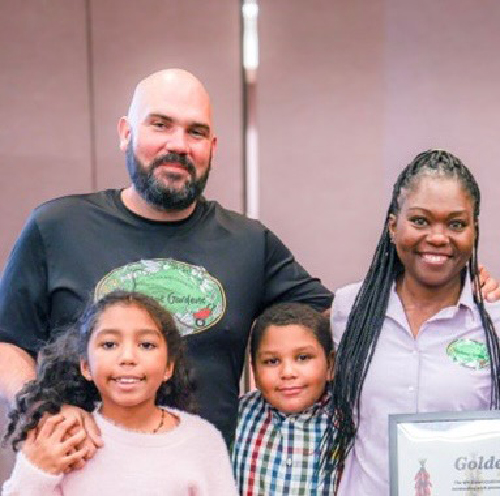
What do you grow?
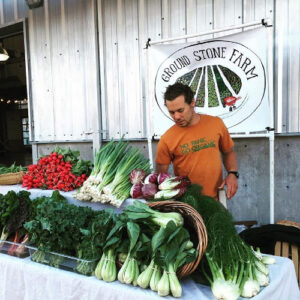
I grow beets, carrots, salad turnips, radishes, lettuce, tomatoes, arugula, kale, greens, cucumbers, and sweet peppers
Where do you sell your food?
I primarily sell to institutional buyers: schools, senior centers, and daycares.
How did you get into farming?
Prior to moving back to New Mexico, we had a landscaping business that focused on soil health. We used organic amendments and advocated for nonchemical fertilizers for use on lawns and landscape plants.
When we moved to Bloomfield, NM, we knew we wanted to create healthier soil through regenerative agriculture practices and realized our community didn’t have access to enough fresh produce. After learning that New Mexico offers many programs to support new farmers, we decided to focus on growing produce and conducting educational programs for the community. This included constructing community gardens at local schools and inviting school groups to take field trips to our farm.
How much capital would a new farmer starting out need?
Our initial startup investment was about $65,000 because there wasn’t any infrastructure on the family land we bought—no electricity, no irrigation or pumping system, no potable water, nothing to start out with.
For a full-time operation with no infrastructure, $50,000 to $80,000 would be the initial startup capital or savings needed. If someone wanted to farm half an acre at their house, generate a good side income, work their regular job, and grow intensely on a smaller scale, it would probably take $10,000 to $15,000 in initial funds.
Did you start out with a mission statement and business plan, or did that come about later?
When we initially started, we knew we wanted to get kids out to the farm. My wife is involved in early childhood education on the state level. She and I both recognize the need for, and believe in, the importance of introducing kids at an early age to farming and where their food comes from. Because we’ve always grown and canned our own food, we knew how much better freshly picked is. Our community was missing out on that experience and we wanted to offer that to them.
As for a formal business plan, we still don’t have one. We ran a business before and realized that during the first year to year and a half, it was going to be a struggle to make a profit. It ended up being two full seasons that we lost money…but we expected that.
We put together some spreadsheets with price points and the volume we needed to sell to make a profit, but were really just winging it. We learned a lot of things on our own and wasted time and money on certain aspects of the farm. If we had another farmer telling us what we were doing wrong, it probably would have helped.
We did establish right away that we wanted to form an LLC or corporation to keep our personal finances and the farm separate. That way, we could track all our losses and really quantify how much we were willing to invest. We had our walk-away point where if the farm was never able to turn the profit that we needed to survive, we would get out. We weren’t just gonna keep throwing money into it.
(The following is the mission statement from Gathings Gardens LLC website https://www.gathingsgardens.com/):
The mission of Gathings Gardens is to provide organic produce to local families using a holistic traditional farming approach. Our farming practices include using solar power, conserving water, and utilizing regenerative agriculture practices. Our mission is to teach these agriculture techniques to future farmers through vocational courses and intern opportunities.
What are the benefits of small acreage farming and what type of equipment do you use?
For a new farmer, a smaller plot that’s less equipment-intensive is the way to go. After looking at the different aspects of farming styles, we felt the market garden was gonna be the best option for us. Although $50,000 to start with sounds like a lot, it’s not if you consider that we were able to do our entire infrastructure for that. You could easily spend that amount on a tractor! It’s nice because now our operating expenses are mostly labor costs.
We have very minimal equipment. We use silage tarps to cover soil or kill weeds. If you were really doing it small, like a quarter acre, you could even get by with just a broadfork for soil preparation. Once your plot is a half an acre or above, a BCS (walk-behind tractor) is nice to have. It is easy to maintain. If something breaks, it’s $800 max to fix versus $3,000 or $4,000 for some major component on a John Deere tractor. We bought a rotary plow to initially break up the ground, then formed permanent raised beds that we plant into. We don’t re-till or redo the soil completely every time.
We have a power harrow for the seed beds and also a flail mower. Whenever we’re done harvesting a crop, we flail mow it and keep the residue in the field as much as possible. We do have a small, 25-hp Kubota tractor, but don’t really use it much in the farming operation. We used it for the initial hard soil breakup and for transferring compost or moving big piles of stuff with the bucket. It gets 10 or 20 hours of use a year, so it’s not mandatory to have.
What are the regenerative agriculture practices you utilize on your farm?
The focus on soil health is important in regenerative agriculture. When we first started, our field had been fallow for a long time. It was mostly sand with less than 1% organic matter. When you first prep a piece of land, initial tillage is necessary. For us, there was so much compaction that a rototiller was only breaking up three to four inches below the surface. We did not want to rotate or invert the soil, so we used a chisel plow (a flat bar that runs 12 inches below the surface) to crack the hardpan and break up the soil.
We then started building up our soil with the addition of organic amendments like manure, then got access to compost. Reducing tillage to no-tillage was the next thing we worked on and incorporated into our practices. We rotate our crops and keep our field planted or covered as much as possible. If there is a fallow area, we cover it with silage tarps or plant a cover crop to improve and loosen the soil.
You use solar power on your farm. Tell me about it
We installed a solar system during our first year of farming. It was hard because I had to stop farming to install it. The weeds took over and we lost that first season…it was horrible, but we had to do it.
The initial investment was about $6,000. We wanted to do solar but were pushed into it too because the quote from the electrical utility provider was $10,000 just for the meter. We were still gonna have to buy a pole and pay an electrician to mount it, then pay for power.
The final cost would have been around $17,000, so that made it really easy to invest $6,000 into a 4-kW, solar-powered system that powers everything day and night. We need to run a 1.6-kW electric pump to irrigate, so if we get three to four cloudy days in a row, our batteries can definitely die and we need to bring in a generator, but that’s rare.
Why do you focus on institutional sales, and tell me about the process?
It was already June, mid-season, when we started farming that first year. After talking to the director of the Harvest Food Hub, who facilitated institutional sales, we were able to complete the paperwork and squeeze in the Tier 1 and Tier 2 food safety trainings that are required to become listed as a supplier on the New Mexico Grown website.
But that first year was horrible—nothing would grow; we grew mostly weeds. We didn’t sell much at the Bloomfield Growers’ Market—it was bad.
The next year, we went to the New Mexico Grown buyer-grower meeting, connected with our local institutional buyers, and stayed in contact with them. When you own a farm, it’s no different than any other business. You have to talk to the buyers, market yourself, and market your business. We were very proficient about getting out there and telling them what we grew, how we grew it, and why we were a good option for them. Sales were good that year and we started drifting more towards institutional buyers. Farming is a lot of work and I was tired of going to the farmers’ market at the end of a long, busy week. I mean, you work all week long, you package all the produce for your institutional buyers, and then on Friday, you have to spend half a day getting everything prepped for market. The next morning at 4 or 5 a.m., you load up all your tables and produce to get it to market by 8 a.m. By late July or August, we’re just tired of that schedule.
For us, institutional sales are easier, because the bigger buyers will generally buy everything we harvest for the week. If we’re able to harvest 300 or 400 pounds of carrots, they’ll buy them. It’s just a lot easier. At the farmers’ market, there’s a risk we won’t sell everything we bring. There’s not that risk with institutional sales, so there’s little to no waste on our end. We’re simply picking for the order and selling it.
Discovering what schools or senior centers will buy came out a bit through the buyer-grower meetings, but it also took a bit of trial and error. We learned pretty quickly that nobody wanted to buy fennel from us. Some of those less common crops, we stopped growing. Even at the markets in this area, there’s not a big following for different sorts of vegetables unfamiliar to most people.
What investments did you need to make in order to sell to institutional buyers?
We invested in cold storage during our second year of operation. We needed somewhere to store the produce so we weren’t harvesting early in the morning and trying to deliver it before it got too hot.
Also, to satisfy the volumes that some of our institutional buyers wanted, we needed to accumulate harvest over two or three days. A washing station is critical for anybody wanting to sell leafy greens. You need some way to prep and clean them. That’s even true for the farmers’ markets. You want to make your products as presentable and as close to what customers are used to seeing as possible.
Do you feel a hoophouse is essential to your farming operation?
We completed our hoophouse in January 2025 and it’s nice to have, but I wouldn’t list it as critical. It helps somewhat for season extension, but the ambient temperature is really the dictator. If it’s 12 degrees outside, no crops are growing outside or inside your nonheated hoophouse either. You’re actually quite limited on what you can grow through the winter anyway, because the natural light is so short, most of your fruiting crops aren’t gonna grow even if you could keep your high tunnels at 70 degrees. There’s just not enough light to grow. Hoophouses do offer more control with foliar diseases during the summer. The tunnels can also get excessively hot, so it’s been a learning experience.
How did you fund your hoophouse?
Our first hoophouse was mostly funded (70%) through a micro-grant awarded to us from Farm to Table’s Farmer Innovation Program in 2024. They cut us a check and we had the funds up front to purchase and erect the hoophouse.
We were awarded two more hoophouses through the NRCS EQIP High Tunnel Initiative grant program and are working on putting them up now. There is a bit more anxiety working with the USDA because you don’t know how long funding is going to take. We have to pre-pay for everything, unlike with our first hoophouse—that’s the big difference.
The EQIP process isn’t difficult but it’s more like a marathon and there’s a lot of paperwork involved. You have to be willing to apply a year in advance and apply at the right time. Then they will lay out a three-year timeline with a checklist of things to be done. There’s nothing inherently difficult about the process, but it’s a bit daunting because of the amount of paperwork, and items must be checked off. The NRCS staff have helped with whatever they can and have been really good to work with.
Are you making ends meet all through on-farm income?
My wife Selece is my silent investor (chuckles). She’s basically kept us afloat for the first two years. Now it’s about a 50-50 split. Last year, I was able to contribute about as much as she did. For new farmers, unless you’re independently wealthy, plan on having a second source of income coming in, at least initially.
How do you handle work- life balance?
We are really good now about saying we’re not gonna work all the time. When we had our last business, we were working seven days a week just trying to make it happen. With our current farm business, we know we will be working six days a week, spring to mid-summer, then trim back the hours to something like 50 hours a week. Towards the fall, it’ll trim it back even farther. It helps mentally to know that it’s not always going to be like this—that I have to get through this time, and it’s going to be okay.
Most farmers enjoy a little bit of time off in the winter where you recuperate. Setting boundaries and making time to spend time with our kids helps maintain work-life balance. We make sure to take them on a couple trips a year, either a road trip to camp or just getting out of the area to see something different.
How do you manage your labor needs?
We started working with students from the internship program at San Juan College. The hardest part was having their schedules change from semester to semester. For example, we have everyone there on Wednesday to get all the harvesting done, but next semester, no one can come on Wednesdays. We have to be flexible and willing to make adjustments.
Nuggets of wisdom to your younger self or to beginning farmers: I’d say the most important thing would be to start small and be sure farming is something you enjoy and are passionate about. We love what we do. We love working with our community. When you start small, you lower the amount of up-front investment while making sure you really want to commit to it. You have the opportunity to learn from failure and make adjustments before jumping out there. It will take a while before you make a profit. Our biggest mistake was starting out planting nine plots of produce on an acre and a half. I’m glad we put in the entire infrastructure in our first year, but planting and trying to manage it all was too much.
My second biggest recommendation would be to get to know some of the farmers in your area. If you can, spend a whole season planning and learning from them before even getting started. If I had done that, I would have started with cover crops and amendments a year in advance of planting due to the fertility issues that first year and may have avoided some of the struggle and hardship.
Talk to as many farmers as possible and get their feedback. It’s not easy being a farmer. These days, it’s very difficult. You have to really like what you’re doing and have the mindset that if you can make enough to justify what you’re doing, then the important part isn’t the money.
Every business needs to be profitable, but your goal should be feeding the community and being a positive presence. You won’t get burned out when your mindset is that you’re adding something that matters.
Thoughts on irrigation… I first made a drawing and sketched out the plot with the infrastructure—where I was going to run my electrical lines—and designed the irrigation system for good coverage. With overhead irrigation, it’s important that your spacing is correct for even watering. We use overhead in combination with drip irrigation. For our overhead irrigation, we use wobblers that run on low pressure—like 10 psi. They are best at 25 psi but can run at 10, so they give you a lot of flexibility. They don’t mist, so you don’t lose any water due to evaporation.
Irrigation problems start when you’re running too much head pressure at the sprinkler and you’ll see misting. You can lose 30% of your water from the evaporating mist. For the drip system, we don’t use drip tape because it’s thin and gets holes easily. We use drip emitters inserted into a poly line that we can reuse for at least five years.